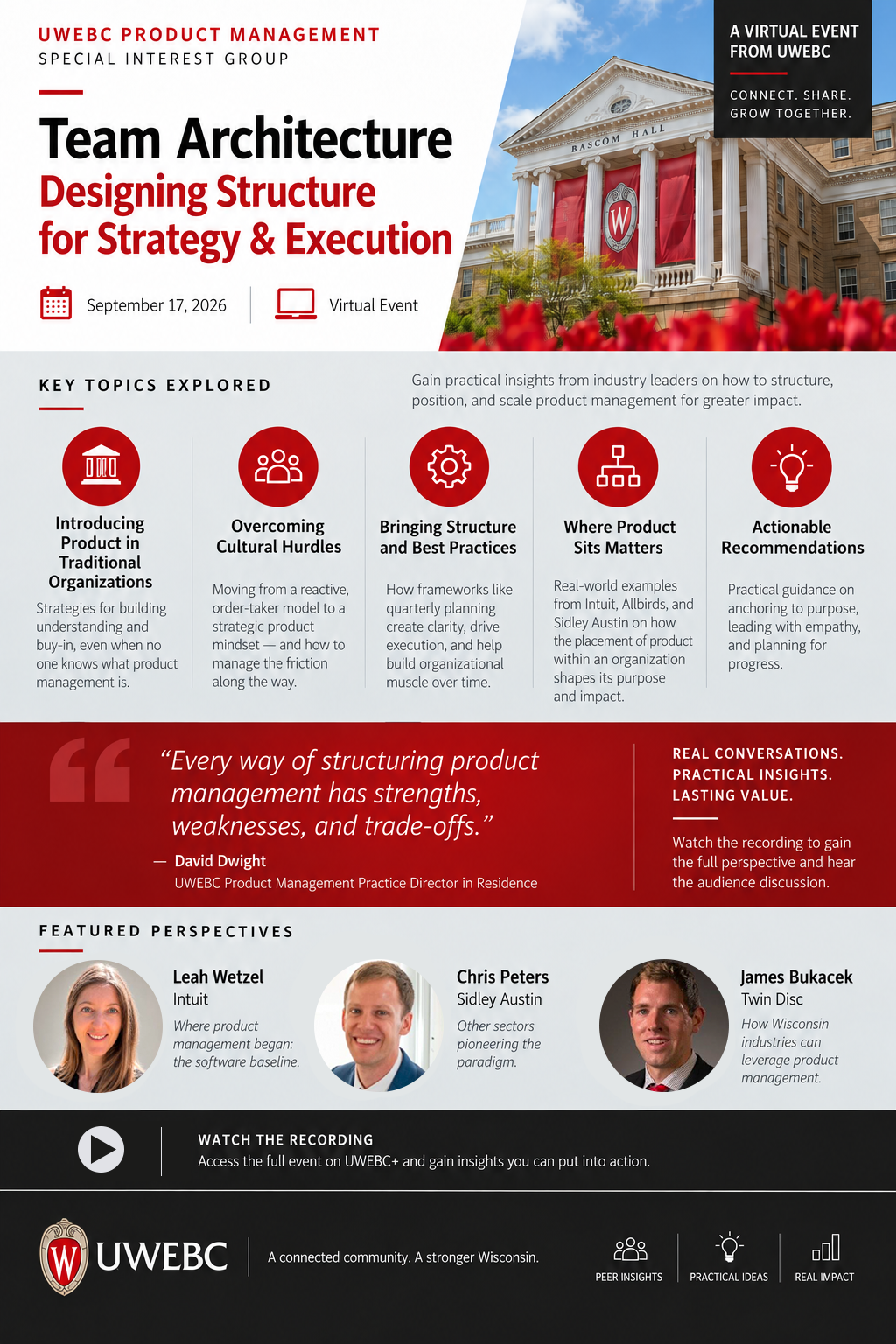
Team Architecture
Designing Structure for Strategy & Execution
Great products are built by great teams, but how those teams are structured can determine whether strategy succeeds or stalls. Explore how leading organizations are designing product teams that improve collaboration, clarify ownership, and accelerate value delivery.
Event Assets
Please login or register for a UWEBC Member Account to access this event's assets.


Description
Every team structure is a wager — a bet on which coordination costs you're willing to pay and which you're not. Functional, matrix, cross-functional pods, platform teams: none of them is "correct." Each solves for certain problems while quietly creating new ones. You get the most out of your structure not by finding the perfect model, but by understanding exactly where your model breaks down and building deliberate countermeasures for it.
This session isn't about redesigning your org chart. Most of you can't do that unilaterally, and that's fine — that's not the point. It's about building a sharper diagnostic eye: recognizing the tradeoffs baked into your current structure, naming the failure modes before they cost you a product launch or a key hire, and identifying practical workarounds that don't require a reorg to implement.
We'll hear from a practitioner panel featuring Chris Peters, Director of Product Management at Sidley Austin; Leah Wetzel, Group Product Manager at Intuit; and James Bukacek, Global Product Manager at Twin Disc.
We'll walk through a few common structural archetypes and their characteristic strengths and blind spots, then turn to the harder question: when you can't change the structure, what do you change instead? Communication rituals, decision rights, informal networks, and role design all offer leverage even when the boxes on the chart stay put.
The second half is open discussion, where you'll bring your own structural tensions to the table and pressure-test them against the group's collective experience.
Audience
These events are designed for product management professionals and leaders who are driving the development of smarter, more connected products.Agenda
| Time | Agenda |
|---|---|
| 9:00 | Welcome and Session Framing |
| 9:10 | Panel Presentations |
| 10:10 | Open Floor Q&A |
| 10:50 | Wrap-Up & Key Takeaways |
| 11:00 | Adjourn |