How culture, technology, and teamwork connect through the trust we build and the responsibility we share.
By Doug Barton
Every time we hand work to a machine, someone else inherits our trust.
They may never choose the tool. They still live with the result. That was one lesson I shared at our 28th annual UWEBC conference, where people came together to learn from one another and take responsibility for what comes next. There was laughter. There were stories that asked us to pause. There was plenty of Wisconsin (the State and the UW) pride. And through it all, there was an invitation to bring our whole selves to the work of leading.
That is the connection I heard across Steve Jones’s opening keynote, my luncheon reflections, and Beyond the Rink with Mark Johnson and Ava McNaughton. Trust grows through our everyday culture. It carries responsibility when we introduce technology. And it helps a team act with confidence under pressure.
Watch the combined plenary highlights — A five-minute look at culture, technology, and teamwork.
The everyday work of building culture
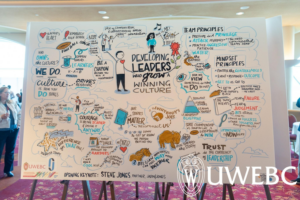
When Steve Jones asked who owns the culture, the answer came back from the room immediately: “We do.”
Steve brought a teacher’s heart to the stage. His success as a football coach gave his message weight, but the story I keep returning to happened long before the championships.
As a fifth grader at a new school, in the middle of a difficult time for his family, Steve forgot his lunch. His teacher noticed. He brought Steve a meal, offered a few simple words, and went on with his day. For the teacher, it was a small act. For Steve, it helped shape the person he would become.
We rarely know the full significance of a moment like that. A colleague may remember the time we listened without rushing. Someone may take a chance because we saw potential they had not yet seen in themselves. The work we do matters deeply to the people who experience it.
Steve’s definition of culture makes that responsibility wonderfully concrete: culture is how we do things. It lives in how we respond under pressure, how we treat one another, and whether we make room for someone else’s voice. Every one of us contributes to it.
He also challenged us to bring a beginner’s curiosity to our expertise. Even accomplished leaders keep learning. And learning asks something of us: choose one idea and put it into practice. A conference can give us new knowledge. We give that knowledge a future through our actions.
The responsibility that travels with trust
At lunch, I shared a story I am still learning from. On July 30, Kate and I ended up in the water in our car after it turned down a boat ramp. We escaped and swam to shore. Fortunately, neither of us was physically hurt.
What I have been thinking about since is how trust travels.
I had thousands of miles of experience with the car. Kate had much less. She was trusting me, and my confidence in the technology was becoming part of her experience. There were three relationships in that car. I had spent time building just two of them.
That triangle reaches far beyond our story. When we introduce a new tool, rely on an AI assistant, or hand a decision to an automated system, other people inherit the consequences of our confidence. They may never have chosen the tool or had the opportunity to understand its limits. Our customers and colleagues can become passengers in decisions we make.
Before a handoff, we owe them some careful questions. If something goes wrong, who will notice? How quickly? Can someone intervene? Who is riding along, and have we asked how they feel about the journey?
The words on my closing slide were a reminder to myself: make trust a decision. As technology becomes more capable, our responsibility to the people affected by it deserves even more attention.
Sharing that story was uncomfortable. The conversations that followed have helped me understand it more fully. That is part of what Together Forward means to me: we make better sense of our experiences when we bring them into conversation with one another.
The preparation behind the moment
Then Mark Johnson and Ava McNaughton brought us Beyond the Rink, with John Stofflet guiding a conversation full of warmth, humor, and lessons for anyone who works on a team.
One moment stood out: Mark asking who wanted to take the penalty shot late in the 2025 national championship game. Ava described teammates standing arm in arm, confident in Kirsten Simms and the skills she brought to that moment.
That confidence had a history. Ava talked about months of practice, learning one another’s tendencies, and keeping communication open. She described the steadiness of a coach whose belief in his team held through the changing score. Trust had grown through repetition and consistency, long before the pressure of the championship.
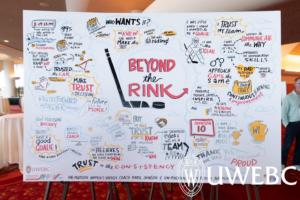
Mark gave us another lesson we can take straight into our workplaces: explain why. He spoke about improving his communication, understanding the person in front of him, and continuing to learn as the game and his players change. Ava reinforced how much it matters to have coaches who understand how each person responds.
And when the conversation turned to legacy, Mark spoke about the people he had helped and the kind of husband, father, and grandfather he hoped to be. Ava remembered a trainer who cared about her life beyond the gym. After all the talk of championships, we came back to the same human truth Steve had offered that morning: people remember how we show up for them.
What we carry forward
I am grateful to Steve, Mark, and Ava for sharing their experience so openly, and to John for helping us find the lessons within their stories. I am grateful to our members, advisory board, sponsors, university partners, and the staff and volunteers who make this community possible. The care behind the microphones and between the sessions is part of the culture, too.
A special thank-you to our graphic recorder, Sherrill Knezel of Meaningful Marks. Sherrill gave our conversations a visual memory. Her drawings preserve both the ideas and the feeling of the day, and invite us to return to what moved us.
My hope is that each of us carries one choice back to work. Get to know the person whose story you have not heard. Make a deposit in someone’s trust. Explain the reason behind a request. Ask who else will feel the effects of a decision. Put one new idea into practice.
Where are you having to build—or rebuild—trust as your team’s work changes? That is a conversation worth continuing with the people who will live with the results of your decisions.
I said from the stage that the future can be more abundant, more productive, more fair, more human, and more joyful. Building it is shared work. I left our conference encouraged by the people willing to do that work, and grateful that we get to do it together.
Continue learning with us
If you weren’t with us in Madison, I invite you to explore a Digital Pass for the 2026 UWEBC Annual Conference and continue learning from the recorded sessions. Start with the highlights, bring an idea into a conversation with your team, and contact our events team about Digital Pass options and access.
2026 Annual Conference Digital Pass
If you joined us, use your conference login link to return to recorded sessions through the end of 2026. Our events team can help if you need your access link sent again.
Together Forward. Forever Forward.
Meet the plenary speakers and graphic recorder | Conference recording access